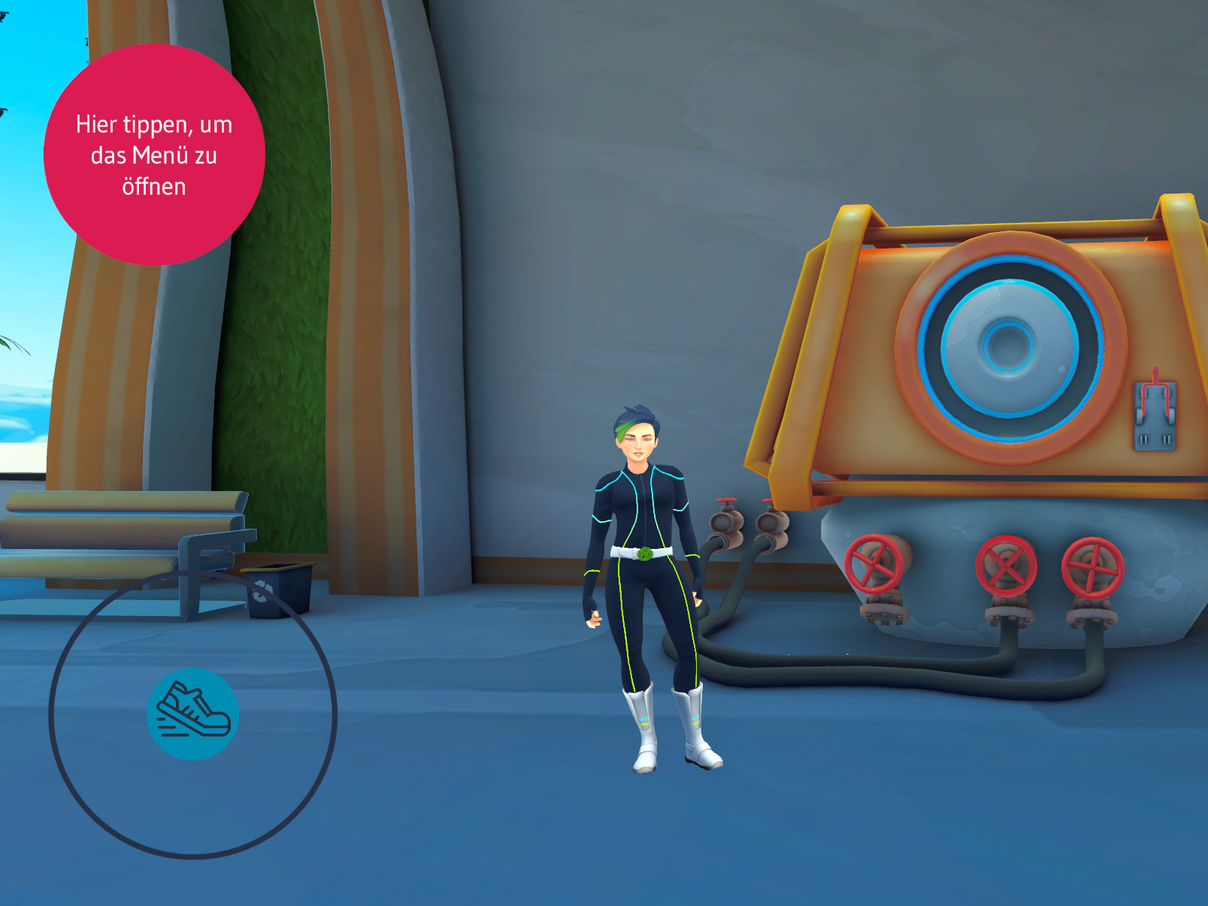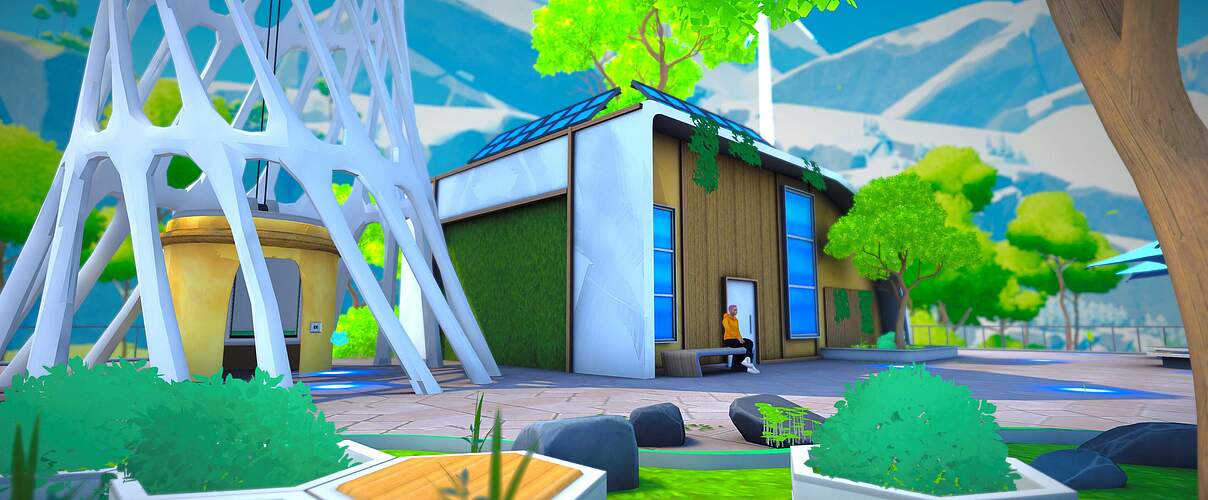
WWF Germany developed the virtual reality experience "Power-to-X: Our Future with Hydrogen" as part of the Kopernikus Project P2X, with the aim of making the opportunities and risks of PtX tangible and easy to understand. The application presents a playful, interactive 3D environment depicting a climate-neutral Germany in 2045 and is aimed primarily at young adults.
Virtual reality (VR) refers to the representation and simultaneous perception of a simulated reality within a real-time, computer-generated, and interactive environment. VR makes it possible to present and communicate complex applications and processes of PtX in an engaging and accessible way within an artificial setting.
In the VR experience, users gain access to key knowledge about PtX. There are several "stations" within the virtual environment that users can explore freely. The advantage of VR lies in not having to follow a linear storyline, while also offering interactive elements (much like a video game) which increases engagement and interest in the content. Each station conveys, in a fun and forward-looking way, the most important applications of P2X in a climate-friendly world.